
Enhance decision making, automate operations, drive growth, cut costs, and scale globally
Dynamics 365 Finance (D365 Finance) is Microsoft’s cloud-based enterprise resource planning (ERP) solution designed to help organizations manage and optimize their financial operations at scale. Tailored for global enterprises, D365 Finance provides real-time visibility into core financial processes such as budgeting, accounts receivable, accounts payable, general ledger, and cash flow forecasting. This solution goes beyond traditional financial management by integrating advanced analytics and automation capabilities.
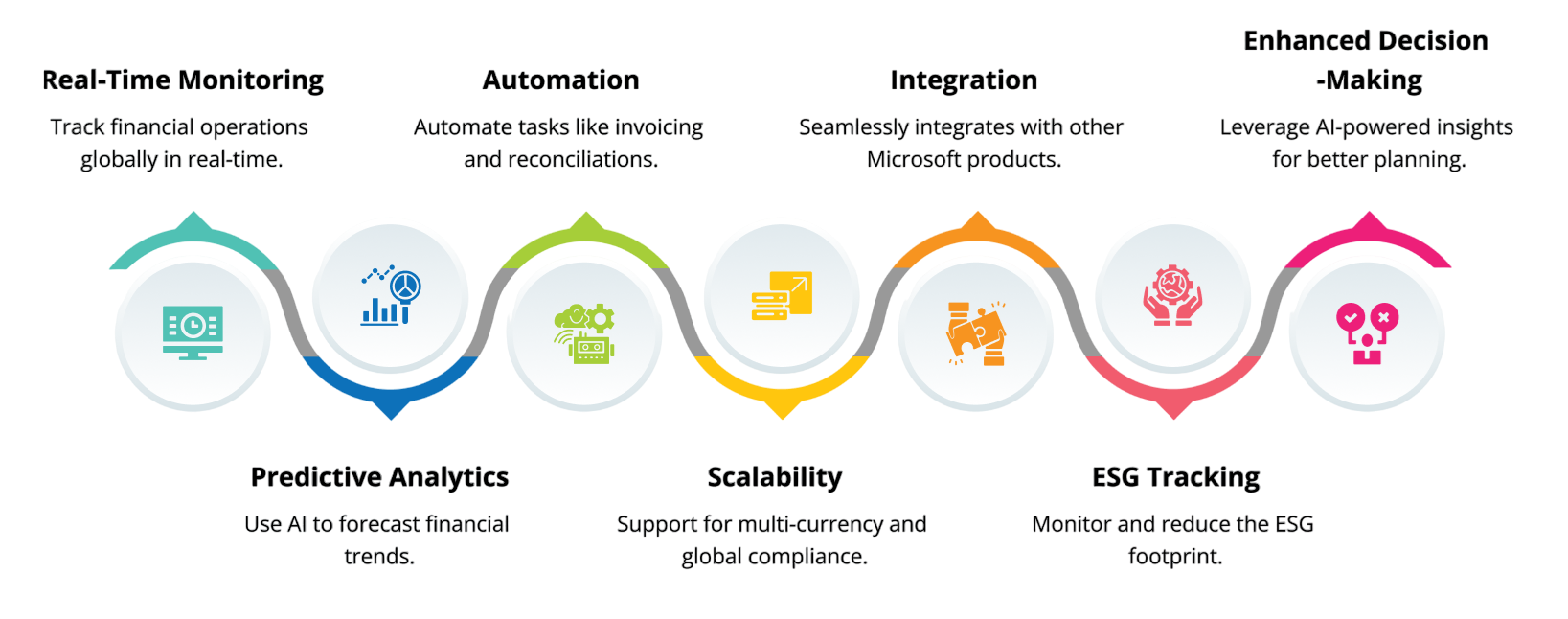
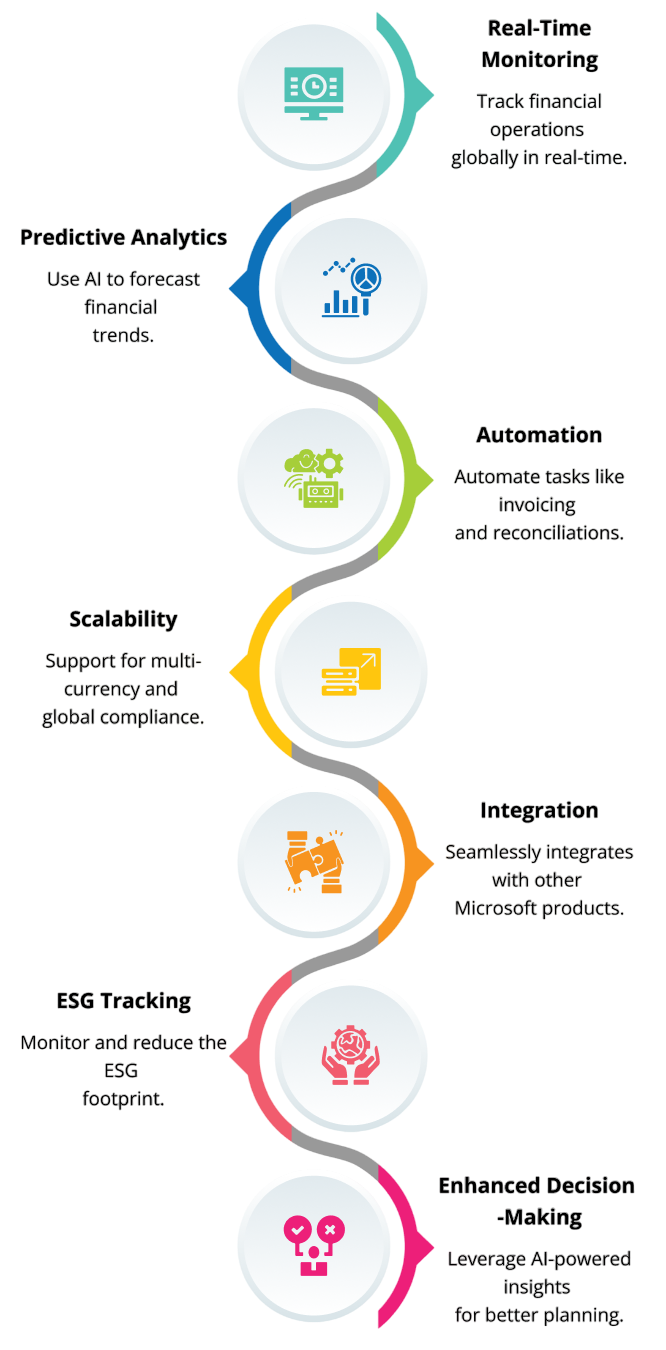
With a tightly connected ecosystem across finance, sales, supply chain, and manufacturing, Dynamics 365 eliminates process gaps and reporting blind spots that hinder real-time decision-making. Finance teams gain continuous visibility into actuals vs. forecast vs. budget, transforming finance into a strategic, cross-functional partner and driver of business performance. By pinpointing variances and enabling faster collaboration, organizations can proactively manage business outcomes and make data-driven decisions with confidence.
Enterprise Performance Management (EPM) has long been a cornerstone of financial strategy, yet real-time FP&A reporting has remained elusive—until now.
D365 Finance automates routine financial processes, such as invoicing, accounts payable/receivable, and bank reconciliations, reducing manual effort and minimizing errors. By establishing process thresholds, finance teams can focus on managing exceptions rather than performing repetitive tasks. The platform streamlines the financial close process by automating data collection across business units, eliminating manual adjustments, and significantly reducing the time and complexity of monthly, quarterly, and annual closes. This automation not only improves accuracy but also allows finance teams to shift their focus from transaction processing to strategic financial analysis.

D365 Finance provides real-time visibility into revenue, margins, cash flow, and portfolio performance, enabling finance teams to make data-driven decisions. Ascent Innovations enhances this by leveraging AI-assisted reports that improve forecasting accuracy and streamline operational planning. This results in greater efficiency, higher profit margins, and superior customer experience.
You can manage all your financial functions—general ledger, accounts receivable, accounts payable, budgeting, and asset management—on a unified cloud platform, simplifying consolidation of financial data across regions, automating processes like reconciliation, and providing detailed financial reports. The modules available within D365 Finance are as follows:
D365 Finance centralizes financial transactions, ensuring real-time accuracy in accounting and reporting. It automates currency revaluation, allocations, and tax management, supporting multi-entity consolidation and compliance for seamless financial oversight and decision-making.
D365 Finance automates invoice processing, approvals, and vendor payments, reducing errors and improving efficiency. Features like invoice matching and payment scheduling ensure accurate cash flow management. With vendor insights, businesses can negotiate better terms and enhance supplier relationships.
D365 Finance automates transaction posting from AP, AR, Fixed Assets, and Cost Accounting to the General Ledger, ensuring accuracy and compliance. With real-time financial tracking, audit-ready reporting, and reconciliation tools, businesses gain better visibility, reduce errors, and streamline financial close processes.
D365 Finance automates asset acquisition, depreciation, and disposal tracking to enhance financial control. With real-time reporting and compliance tools, businesses can optimize asset investments, reduce manual errors, and ensure accurate financial statements.
D365 Finance streamlines invoicing, payment tracking, and collections for improved cash flow. Automated workflows manage credit, interest, and billing adjustments, reducing manual effort and errors. With real-time insights, businesses enhance receivables management, improve customer relationships, and optimize revenue collection.
D365 Finance automates expense tracking, approvals, and reimbursement workflows, improving policy compliance and financial visibility. With mobile access and real-time reporting, businesses can reduce administrative burdens and gain control over organizational spending.
D365 Finance enables detailed cost tracking, allocation, and analysis across business units. With real-time insights, finance teams align spending with strategic goals, identify inefficiencies, and optimize cost structures. Seamless integration ensures data consistency and accurate financial planning.
D365 Finance automates tax calculations, audit tracking, and financial controls to ensure compliance with local and global regulations. With real-time reporting and audit trails, businesses reduce risk, enhance transparency, and maintain regulatory readiness.
D365 Finance provides full visibility into product costs, including COGS and SG&A, helping businesses analyze profitability and adjust pricing strategies. With AI-driven cost tracking, companies can reduce waste, optimize margins, and make data-backed portfolio decisions.
D365 Finance automates lease tracking, payment schedules, and compliance with IFRS 16 and ASC 842. Businesses gain real-time insights into lease liabilities and right-of-use assets, improving financial accuracy and decision-making.
D365 Finance delivers real-time cash flow visibility with AI-powered forecasting. Businesses can anticipate liquidity needs, optimize working capital, and reduce financial risk. Automated receivables and payables tracking enhances cash flow management and supports strategic growth investments.
D365 Finance streamlines recurring billing, revenue recognition, and contract management for subscription-based businesses. With automated invoicing and revenue deferrals, organizations can improve accuracy, enhance customer relationships, and maintain compliance.
D365 Finance streamlines financial planning with rolling forecasts, budget controls, and scenario modeling. With real-time tracking and integration across departments, businesses can optimize resource allocation, improve financial predictability, and align spending with strategic goals.
D365 Finance centralizes credit limits, collections, and payment tracking to improve cash flow. With automated dunning letters, risk scoring, and forecasting, businesses can reduce overdue payments, manage credit risk, and improve financial stability.
D365 Finance simplifies bank transactions, reconciliations, and liquidity management. With automated payment processing, foreign currency revaluation, and centralized bank operations, businesses can improve cash flow efficiency, reduce financial risk, and ensure compliance.
Our approach includes:
With a proven track record in ERP modernization and financial analytics, Ascent Innovations is the trusted partner for companies looking to leverage D365 Finance for long-term success.

Wisconsin-based steel tube manufacturer for automobiles, engineering, and agriculture.
Private Equity ownership
Wisconsin-based certified electronic recycler with 5 facilities and 28 sites.
Refurbishes Computers and mobile devices.
Multiple levels of government and OEM contracts.
Simplified Receiving and redesigned Recycling process.
Customer portal. Ordering, Reconciliation, Settlements.
Directives, Workflows and Certifications for Compliance.
Dock scheduling Calendar and Power BI for analytics.
System flexibility for reverse-production process.
Reconciling Sales orders with Material Receipts.
Asset Disposition tracking, quality controls and auditing.
EPA, ITAR, State Compliance laws and Certifications.
Ascent Innovations LLC follows a structured implementation approach that includes business process analysis, system configuration, data migration, testing, and user training. Our consultants work closely with your finance and operations teams to ensure the system aligns with your organization’s financial processes, reporting requirements, and compliance standards
Ascent Innovations LLC offers a full range of services for Microsoft Dynamics 365 Finance including implementation, system integration, customization, data migration, financial reporting setup, user training, and ongoing support. Our goal is to help organizations streamline financial operations and maximize the value of their ERP investment.
Ascent Innovations LLC provides experienced consultants, industry best practices, and tailored solutions for Microsoft Dynamics 365 Finance. We focus on delivering scalable ERP solutions that improve financial visibility, automate processes, and support business growth.
Microsoft Dynamics 365 Finance is a cloud-based enterprise resource planning (ERP) solution designed to help organizations manage financial operations, automate accounting processes, monitor business performance, and ensure regulatory compliance
Key features include general ledger management, accounts payable and receivable, budgeting, financial reporting, cash and bank management, asset management, global financial consolidation, and AI-driven financial insights.
Dynamics 365 Finance is typically designed for medium to large organizations with complex financial operations. However, growing businesses can also benefit from it if they require advanced financial management, automation, and scalability.
Yes, Dynamics 365 Finance integrates seamlessly with Microsoft tools such as Excel, Power BI, Microsoft Teams, and other Dynamics 365 applications like Supply Chain Management and Sales.
Yes, Dynamics 365 Finance is primarily a cloud-based solution hosted on Microsoft Azure. It provides secure access from anywhere while supporting scalability, automatic updates, and advanced data security.
The platform provides real-time financial dashboards, customizable reports, and advanced analytics. Integration with Power BI enables organizations to gain deeper insights into financial performance and make data-driven decisions.
Dynamics 365 Finance is widely used across industries such as manufacturing, retail, professional services, finance, healthcare, and distribution, particularly in organizations that operate across multiple entities or countries.