


The food manufacturing industry is navigating rising costs, evolving consumer demands, and intensifying supply chain disruptions. Shifting consumer preferences require greater product variety, faster delivery, and transparency around ingredients and sustainability. At the same time, manufacturers must manage perishable inventory, comply with stringent food safety regulations, and control costs amid fluctuating material prices and global trade uncertainties.
Despite the wealth of data available, many food manufacturers struggle to turn insights into action. Without real-time visibility into inventory, demand forecasting, and production planning, decision-makers are often forced into reactive strategies rather than proactive optimization.
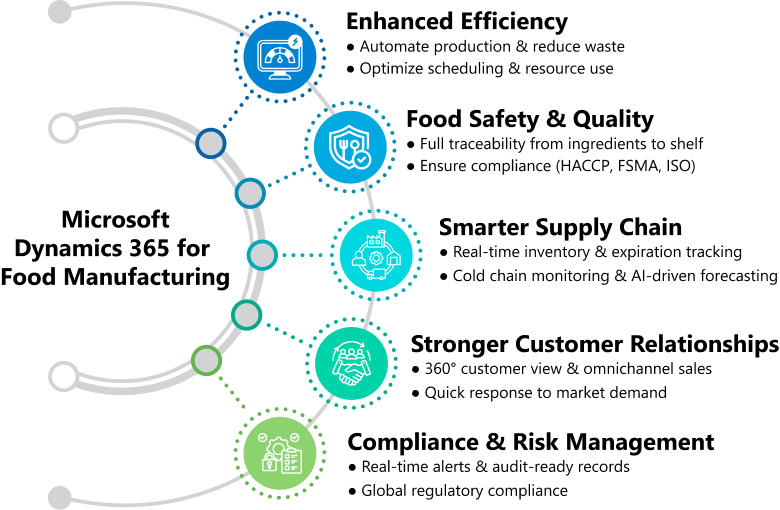
Modernizing business processes and analytics with Dynamics 365 Finance and Supply Chain provides end-to-end visibility, real-time data insights, and automation—helping food manufacturers adapt quickly to market changes, regulatory shifts, and supply chain challenges while maintaining profitability and competitive pricing.

End-to-End Supply Chain Visibility
Food manufacturers must track raw materials, production schedules, and finished goods with precision to meet food safety standards and consumer expectations. D365 Supply Chain ensures real-time monitoring and process control by:
With real-time supply chain insights, manufacturers can quickly respond to demand fluctuations, improve food safety compliance, and optimize production efficiency.

Production planning and compliance-driven manufacturing
Food manufacturers operate in a highly regulated and time-sensitive environment where efficiency and compliance go hand in hand. D365 helps improve production workflows by:
By automating critical production processes, manufacturers can reduce operational costs, minimize food waste, and maintain compliance with regulatory requirements.

Inventory and expiry management
Perishable inventory management is one of the most complex challenges in food manufacturing. D365 provides:
With predictive analytics and automated inventory control, food manufacturers can extend shelf life, minimize waste, and improve order fulfillment.

Supplier & Procurement Optimization
Supply chain disruptions and ingredient shortages have increased procurement challenges. D365 enables food manufacturers to:
By optimizing procurement, manufacturers can secure a reliable supply chain while minimizing cost fluctuations and regulatory risks.

The food industry operates on tight margins, making cost visibility and financial efficiency essential. D365 Finance delivers:
By automating financial processes and improving cost visibility, food manufacturers can control operational expenses and improve profitability.
Food manufacturers must adhere to FDA, USDA, HACCP, and global food safety regulations. D365 Finance ensures compliance by:
With built-in compliance tools and automated audit tracking, manufacturers can reduce regulatory risks and maintain consumer trust.
End-to-end ingredient and batch traceability for food safety and compliance
Successfully implementing an ERP tailored to food manufacturing requires deep industry expertise. Ascent Innovations is a trusted Microsoft partner with extensive experience helping food manufacturers modernize operations, enhance compliance, and drive measurable ROI.


Food manufacturers that continue relying on legacy systems and disconnected processes will struggle to keep up with changing regulations, rising costs, and evolving consumer demands.
D365 Finance and Supply Chain provides a scalable, AI-driven platform to streamline food manufacturing operations, ensuring faster time to market, optimized inventory management, and seamless regulatory compliance.
By partnering with Ascent Innovations, food manufacturers can modernize their ERP, improve operational efficiency, and maintain food safety and regulatory excellence—positioning their business for sustained growth and competitive advantage.
Mediterranean cuisine – Kitchen with a 2-tier production and
delivery model.
Centralized kitchen for R&D, Recipe Mgmt., Purchasing.
Retail Outlets for final step production & customizing orders.
Illinois-based manufacturer of injectable grade ingredients
for medicines and vaccines, promising purity.
Contract manufacturer of Vaccine and Biologic stabilizers.
Manufacturer of Low-metal and Low-Nitrosamine excipients.
Positioning for growth in high-purity products and services.
Ascent365 enables food manufacturers to transform operations using solutions like Microsoft Dynamics 365 Supply Chain Management and Microsoft Dynamics 365 Finance. We deliver real-time supply chain visibility, automated production planning, and integrated compliance tracking—helping organizations improve efficiency, reduce waste, and meet strict food safety standards.
Ascent365 follows a business-first, compliance-driven approach tailored to the food industry. From implementation to continuous optimization, we ensure systems support traceability, regulatory compliance, and operational excellence—while driving measurable ROI through automation, analytics, and process improvements.
End-to-end traceability can be achieved by integrating data across ingredients, production batches, and distribution channels. This enables real-time tracking, supports food safety compliance, and allows faster response to recalls or quality issues.
Technology enables automated batch tracking, allergen control, and real-time monitoring of production processes. It also supports audit-ready reporting and ensures compliance with regulations such as those from U.S. Food and Drug Administration and United States Department of Agriculture.
Perishable inventory can be managed through real-time shelf-life tracking, automated replenishment, and optimized stock rotation. These capabilities help reduce waste, prevent spoilage, and improve overall inventory efficiency.
Organizations can improve procurement by automating supplier evaluations, enhancing collaboration, and using analytics to make better purchasing decisions. This reduces risks, ensures quality, and improves cost efficiency.
Integrating financial systems with operations provides real-time visibility into costs, profitability, and cash flow. It also ensures accurate reporting and compliance, helping businesses make informed decisions and maintain sustainable growth.