


Warehouse and distribution companies face increasing complexity as tariffs, supply chain volatility, and shifting trade policies create significant challenges. Higher procurement costs, logistics disruptions, and fluctuating demand are putting pressure on margins and operational efficiency. The unpredictability of tariff implementation, short-term reversals, and retaliatory trade measures add further complexity, requiring businesses to be highly agile and responsive.
To remain competitive, companies must take a proactive approach to pricing, inventory management, and operational efficiency. Those who leverage real-time data, automation, and predictive analytics will be best positioned to navigate cost fluctuations, maintain profitability, and improve service levels in 2025.

Predictive forecasting for demand and replenishment
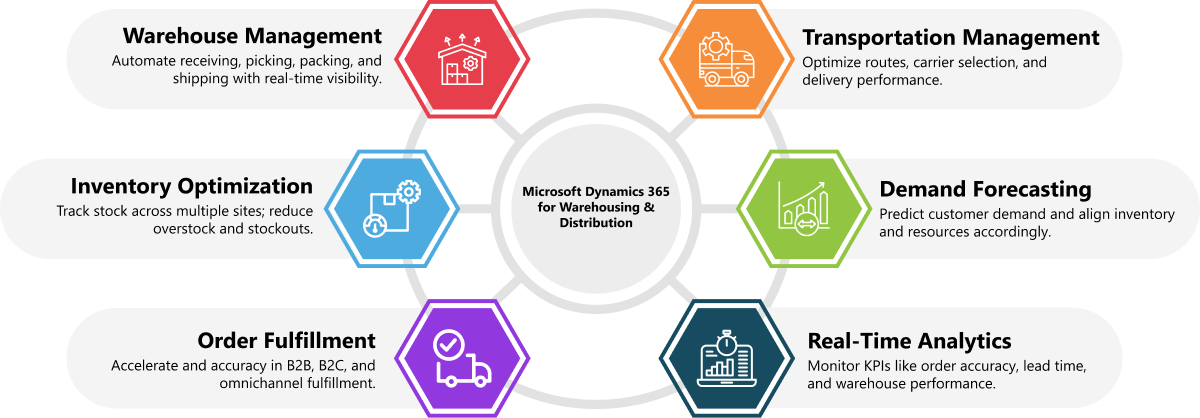
Accurate demand forecasting is critical for ensuring optimal inventory levels and reducing last-minute procurement costs. Poor forecasting leads to stockouts, overstocking, and unnecessary storage expenses. D365 Supply Chain helps by:
With AI-powered forecasting and automated replenishment, companies can better anticipate customer needs and reduce inventory inefficiencies.

Real-time inventory management
Accurate inventory tracking is essential for preventing shortages, reducing overstock, and optimizing warehouse space. D365 enables:
By enhancing inventory accuracy and optimizing stock turnover, companies can improve fulfillment speed and reduce waste.

Order fulfillment optimization
Meeting customer expectations for faster, more accurate deliveries requires streamlined order fulfillment processes. D365 supports:
With intelligent warehouse workflows, companies can accelerate order fulfillment and improve customer satisfaction.

Warehouse space utilization
Maximizing warehouse capacity is key to reducing storage inefficiencies and optimizing material flow. D365 enhances warehouse utilization by:
By optimizing warehouse layout and material handling, businesses can maximize efficiency while lowering storage costs.

Labor management and productivity
With labor shortages impacting warehouse and distribution centers, efficient workforce management is essential. D365 helps improve productivity by:
With real-time productivity tracking and optimized labor allocation, companies can increase efficiency while managing workforce challenges.

Shipping and logistics visibility
Maintaining real-time shipping visibility ensures on-time deliveries and cost-effective logistics operations. D365 integrates with transportation management systems (TMS) to:
With integrated logistics tracking and cost optimization, companies can improve delivery performance and reduce shipping expenses.

With tariffs and fluctuating costs impacting profitability, companies must enhance financial oversight and budget management. D365 Finance enables:
By automating financial planning and optimizing cost structures, companies can maintain profitability despite market volatility.
Companies need flexible pricing models to adjust for tariffs, demand shifts, and cost fluctuations. D365 enables:
By leveraging intelligent pricing automation, companies can react quickly to cost fluctuations while maximizing revenue opportunities.
Predictive demand forecasting to optimize inventory levels and reduce stockouts
Successfully implementing an ERP solution tailored to warehouse and distribution challenges requires deep industry expertise in pricing strategies, supply chain resilience, and financial management. Ascent Innovations is a trusted Microsoft partner with extensive experience helping companies optimize operations, improve cost control, and drive measurable ROI.


Warehouse and distribution companies must adapt to supply chain disruptions, rising costs, and evolving trade policies to remain competitive. Companies relying on manual processes and outdated pricing strategies risk higher costs, slower response times, and reduced profitability.
D365 Finance and Supply Chain provides a scalable, AI-driven platform to help companies optimize pricing, automate financial management, and strengthen supply chain resilience, ensuring they can adapt to market uncertainty while protecting margins and customer relationships.
By partnering with Ascent Innovations, warehouse and distribution companies can modernize their ERP, enhance pricing flexibility, and improve financial agility—positioning their business for long-term success in a rapidly evolving trade environment.
Setting up a Colorado-based company for the US market.
Ohio-based leader in specialty coating and sealants.
Member of Fortune 500 with $7.3B in global sales.
50+ brands, 17,000 employees, 119 manufacturing facilities
Mediterranean cuisine – Kitchen with a 2-tier production and
delivery model.
Centralized kitchen for R&D, Recipe Mgmt., Purchasing.
Retail Outlets for final step production & customizing orders.
Ascent365 helps businesses transform warehouse and distribution operations using solutions like Microsoft Dynamics 365 Supply Chain Management and Microsoft Dynamics 365 Finance. We enable real-time inventory visibility, AI-driven demand forecasting, and automated fulfillment processes—helping organizations reduce costs, improve efficiency, and deliver faster, more accurate customer service.
Ascent365 follows a business-first, ROI-driven approach designed to address the complexities of modern supply chains. From initial assessment to implementation and continuous optimization, we ensure improved operational performance, strong user adoption, and measurable business outcomes.
Businesses can use AI-driven forecasting to analyze historical and real-time data, enabling more accurate demand predictions. This helps align procurement with demand, reduce stockouts, and avoid excess inventory.
Real-time inventory management provides visibility across multiple locations, enabling accurate stock tracking, automated reconciliation, and better inventory control. This improves fulfillment speed and reduces discrepancies.
Optimized fulfillment processes—such as automated picking, packing, and batch processing—improve order accuracy and speed. This leads to faster deliveries, reduced errors, and higher customer satisfaction.
Warehouse efficiency can be improved through AI-driven slotting, optimized layouts, and automated storage processes. Labor productivity can be enhanced by tracking performance, automating scheduling, and reducing manual tasks.
Integrating logistics with financial systems provides real-time insights into costs, profitability, and cash flow. It also enables better pricing strategies, route optimization, and overall cost control—helping businesses maintain margins in a competitive market.